
Summary of the History of the 95th Regiment of Foot
During the 18th century, the line infantry was the most important component of the European armies, since it made up the bulk of the troops mobilised and also because it had acquired a tactical superiority over the cavalry.
Muskets were the universal armament. They were flintlock weapons, with complicated loading operations. This meant that only one or two balls were shot in a minute by a line infantryman with good training. In addition, the flintlock muskets of this period were all smoothbores and were extremely inaccurate. When a ball was fired, it came out from the weapon without a precise direction since there were no grooves inside the barrel to guide it. A flintlock musket was of use when fired at 100 or so metres from the target. As a result, during a battle, the line infantry formations had to come very close.
In January 1800, several line regiments was required to send one captain, one lieutenant, one ensign, two sergeants, one corporal and 30 of its best privates to be trained as riflemen. The chosen men, the best marksmen of their units, would make up a new independent corps of riflemen. The initial idea of the Duke of York was to train these elite soldiers as riflemen then return them to their original units in order to act as the core for the formation of rifle companies in each line regiment. At this time, the use of accurate weapons to shoot officers and disrupt command systems was frowned upon as a tactic in warfare.
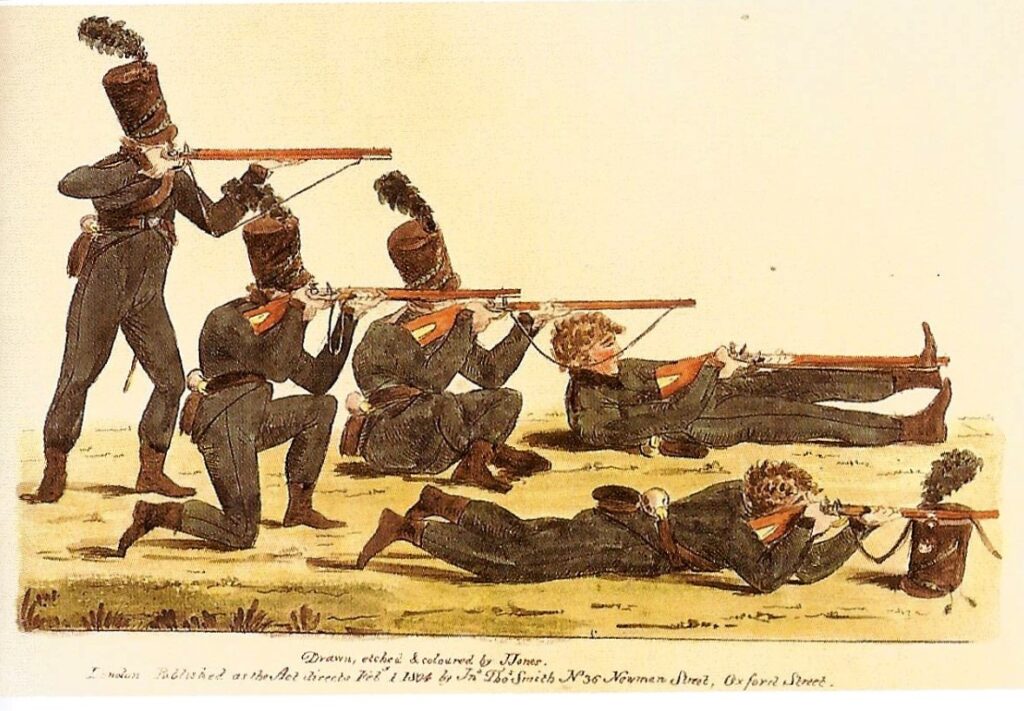
Different firing positions for Riflemen
This sketch was by J. Jones in 1804 and was published by Thomas Smith of London.
It shows the large range of firing positions available to Rifleman – completely different to the standard line infantry firing position. leatherwork.
The defining feature of a rifleman is of course that he uses a rifle! A grooved barrel made the ball spin as it went, thus ensuring much greater accuracy than the smoothbore musket. Unlike the long rifles used by the Americans, the British Ordnance preferred short barrelled rifles. A trial was held in February 1800 between several English and foreign rifles. The winner was a weapon designed by the gunmaker Ezekiel Baker and it was his pattern that was put into production and remained in use throughout the period, officially known as the Pattern 1800 Infantry Rifle. This rifle had a 30 inch barrel, with quarter turn, seven groove rifling. It’s performance was not the best in the trial, but it was easier to load. It also used existing standard infantry carbine ammunition of .625 inches.
The temporary training unit that had just been created was called the ‘Experimental Corps of Riflemen’ and was commanded by Colonel Coote Manningham (1765–1809) an expert light infantry officer of the British Army. Manningham trained the riflemen according to his own innovative ideas, which were published in 1800 as the Regulations for the Rifle Corps formed at Blachington Barracks under the command of Colonel Manningham.
Training the new experimental corps was intensive and comprised field exercises that were made as realistic as possible. The basic idea was that of training soldiers who could think in an autonomous way and act rapidly according to circumstances. Individual capabilities were fundamental in this regard. Training included moving swiftly on broken terrain, surviving with limited food rations, skirmishing on the open field, penetrating the enemy’s lines without being noticed, launching surprise attacks to occupy enemy outposts, scouting for larger units during an advance and acting as rear-guard to cover a retreat. The new riflemen were given dark green uniforms and black leather equipment.
From October 1800 it became known as the Rifle Corps. In February 1801, it was transferred to the official establishment of the infantry and became a permanent unit; in 1802, it was officially transformed into a regiment and received the denomination of 95th Rifle Regiment.

95th Rifle Regiment at war
During the following years, the riflemen took part in all the most important campaigns fought by the British Army, always distinguishing themselves and winning an impressive amount of awards. Due to their superior training and morale, they were usually employed as special forces. In 1805, a 2nd Battalion was added to the Rifle Regiment, followed by a 3rd Battalion in 1809. The two new units underwent the same training as the original and acquired the same special status.
The 1st Battalion of the 95th Foot sent one of its companies to Denmark in 1801, and during 1805 it participated in the military operations taking place in Hanover, which was occupied by Napoleon’s troops.
- In 1807, five companies of the battalion participated in an unlucky expedition sent to South America. All were captured during an assault against Buenos Aires.
- During 1808, all ten companies were sent to the Iberian Peninsula, where they fought with enormous valour until 1814.
- Due to heavy casualties, in 1810, the companies were reduced to eight and then to six in 1813. During that year, one company participated in operations in the Netherlands.
- In 1815, the entire battalion took part in the Belgian Campaign and fought at Waterloo.
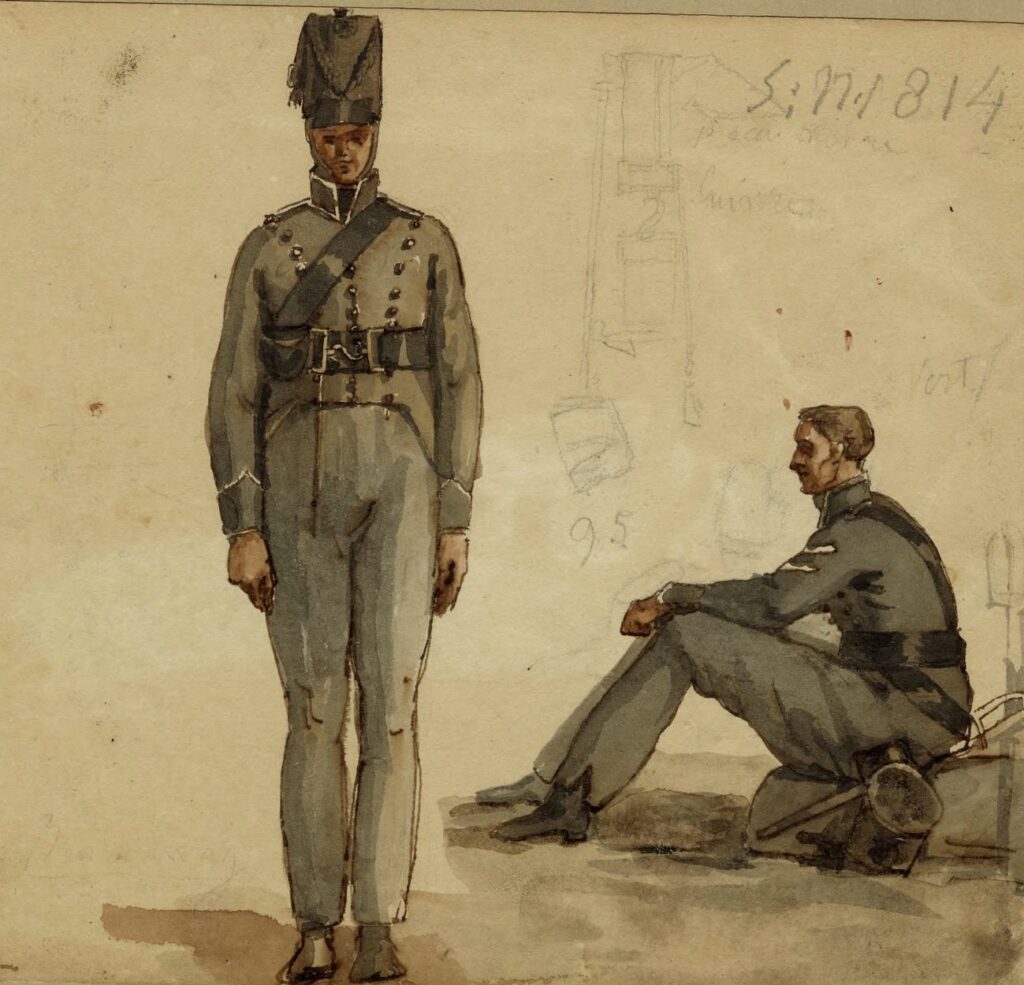
Sketch of a 95th Rifleman in 1814
This sketch was by Sebastien Norblin in 1814 and gives us an idea of what these men may have looked like – some of the elements may be exaggerated or reduced for ‘artistic licence’.
It does show the cut of the green Regimental uniform and how the leatherwork was black, whereas line infantry normally had white leatherwork.
Of these campaigns it was those in the Peninsular – Spain and Portugal – which marked them out as special. They fired the first shots of the Peninsular War at Obidos in 1808. They endured the terrible trial of the retreat to Corunna by Moore’s army. In 1809 they were increased to three battalions. Throughout the Peninsular War the rifleman were at the forefront of virtually every action as part of the Light Division.
The Light Infantry
From July 1803, the three units training at Shorncliffe were united to form a Corps of Light Infantry commanded by Moore. In September 1805, the re-training of the 43rd and 52nd Foot was completed and both units were later sent to the Iberian Peninsula. Here, together with most of the 95th Rifles and with some allied units, they formed a special Light division that acted as Wellington’s special corps.
The composition of the Light Division varied but always included divisions of the 95th. The men of the Light Division joked that it was called ‘Light Division’ because they were so often ‘light’ on provisions. This was because they were so often acting as advance or rear guards, some distance from the main army.
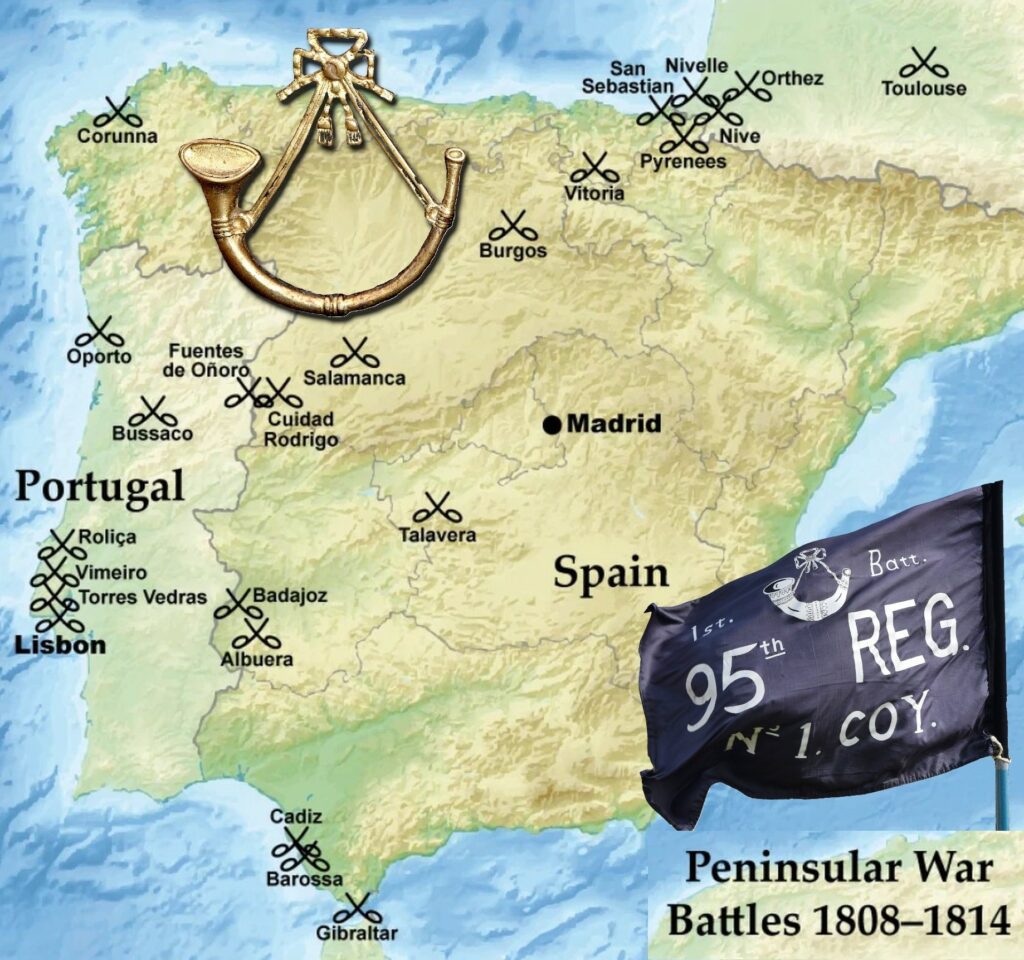
Peninsular War Battles 1808 -1814
This map shows the major battles involving the 95th Regiment as part of the Light Division during the key stages of the war in Portugal and then Spain, before the invasion of France.
It also shows how the Light Division badge of the bugle is used in various forms on uniform and flags.
Despite these and other privations they endured, they became hardened campaigners who were dismayed by nothing. George Simmons of the 95th said: “I feel great pleasure to be with such fighting fellows and hardy soldiers. The men are so seasoned that rain or any other kind of weather makes no impression…we have been without tents for months together, sleeping on the ground without any other covering than the canopy of heaven” His comments showed the high morale of the men. As soon as the French were sighted, they were engaged with enthusiasm.